Prepaid credit cards explained: Here’s how they really work!

Whether you’re travelling, shopping online, making your first card payments or using them in a business context: prepaid credit cards are versatile and help you manage your spending effectively. But how exactly do they work – and how do they differ from debit cards and traditional credit cards? We explain the key points.

How does a prepaid credit card work? The principle explained simply

The basic principle is simple: before you can use it to pay for anything, you first need to top up the card with credit. You can then use this credit for purchases, online payments or cash withdrawals. For example, if you top up your prepaid credit card with CHF 500 and use it to pay for a purchase costing CHF 80, CHF 420 will remain on the card. Each payment is deducted directly from the available balance.

This is one key way in which a prepaid credit card differs from a traditional credit card: a prepaid credit card does not provide a traditional credit limit.

Payments are deducted directly from the balance you have previously topped up and therefore do not need to be settled at a later date via a credit card statement.

When making a payment, you’ll hardly notice any difference. Depending on the card, you can use a prepaid credit card to pay in-store, online or contactless, and you can also use it with your smartphone or smartwatch. Swiss Bankers’ prepaid credit cards operate on a prepaid basis and are not directly linked to a bank account. This allows you to manage certain expenses – such as travel or online purchases – separately from your everyday bank account.

Good to know: if your balance is running low, you can top up your prepaid credit card. The top-up options and limits available depend on the specific card and the provider.
Prepaid, debit or credit card: what’s the difference?

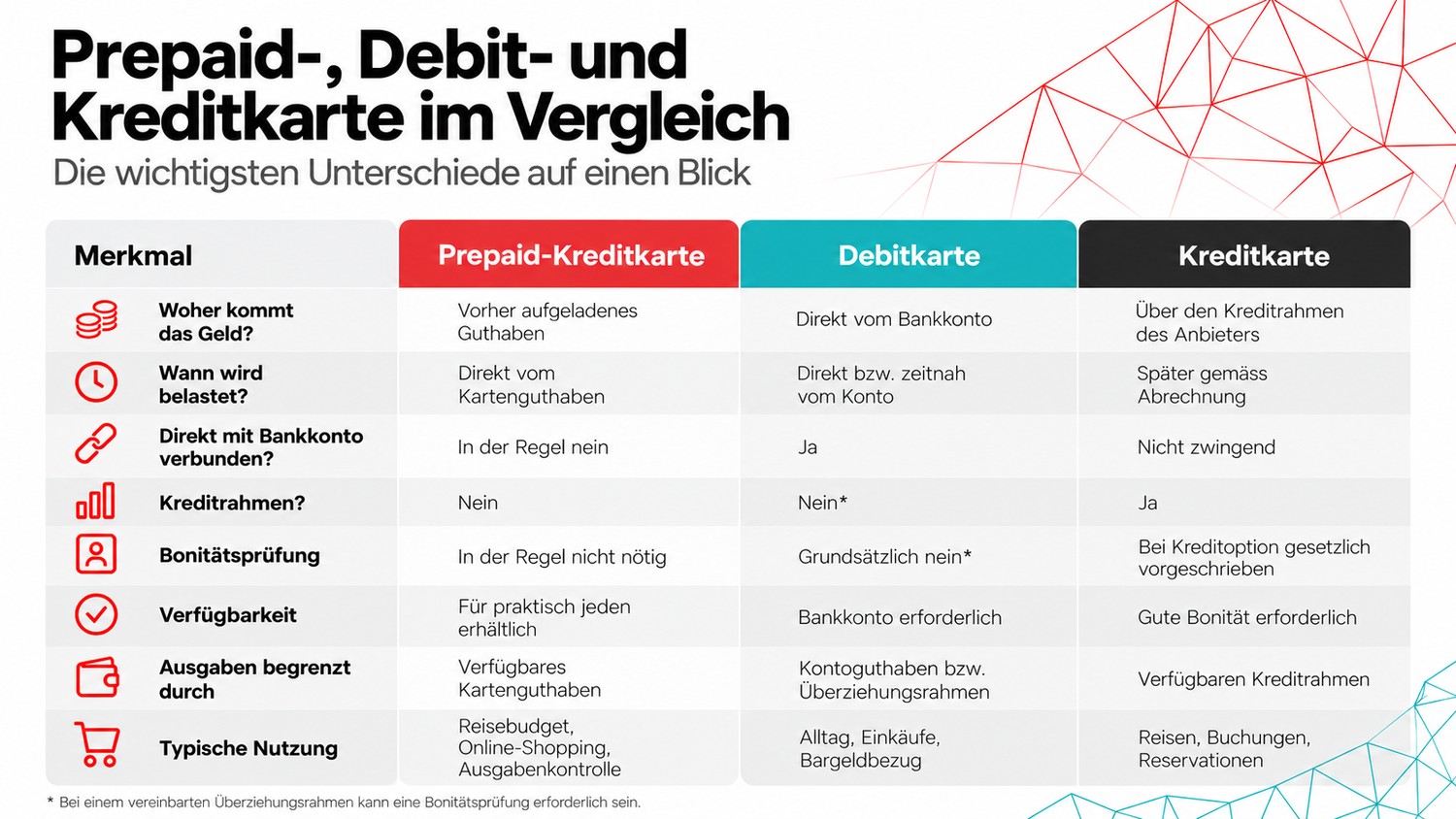
Prepaid, debit and credit cards look similar and are often used in the same way when making payments. The key difference, however, lies in where the money for a payment comes from and when it is debited.

Let’s say you’re buying headphones for CHF 120:

  • With a prepaid card, you pay using the balance you have previously loaded onto the card. If there is CHF 300 on the card, the CHF 120 is deducted directly from it.
  • With a debit card, the amount is debited directly or shortly afterwards from the linked bank account. To do this, there must generally be sufficient funds in the account or an agreed overdraft facility available.
  • With a standard credit card, you pay within a set credit limit. The payments made are aggregated and settled later in accordance with the agreed terms and conditions.

In a nutshell:

  • Prepaid: top up your balance → pay
  • Debit: pay from your bank account
  • Credit: use credit limit → settle later

The term ‘prepaid credit card’ may therefore seem somewhat contradictory at first. Instead of using a credit limit, you pay with credit you have topped up in advance. Which type of card best suits your needs therefore depends primarily on how you organise your spending and what you intend to use the card for.

Travel: The free prepaid credit card

Pay securely with the Travel prepaid credit card at over 70 million shops worldwide. Available in CHF, EUR and USD. Manage your balance via the app. Cash withdrawals at home and abroad. Order online now – no credit check required, in just 5 minutes!

Learn more

What are the advantages of a prepaid credit card?

The key advantage of a prepaid credit card becomes apparent even before you make a payment: you decide for yourself how much money is available on the card. Instead of only seeing your spending after the fact, you set your budget in advance.

  • Allocate your budget specifically: a coffee here, an online purchase there and a meal out whilst on holiday – lots of small payments can quickly add up. With a prepaid card, you can set a separate budget for specific expenses. For example, if you’re planning to spend CHF 1,000 on your holiday, load this amount onto the card and use it to pay for your travel expenses. This keeps your travel budget clearly separate from your other finances.
  • Keep spending separate from your bank account: A prepaid credit card does not need to be directly linked to your bank account. Payments are made using the balance on the card. This can be handy for online shopping, for example: instead of using a card directly linked to your everyday bank account, you can pay for online purchases using a separate card balance.
  • Prepaid does not automatically mean a physical card: An often-overlooked point is that ‘prepaid’ describes where the money for the payment comes from – not the form the card takes. Prepaid credit cards can therefore also operate entirely digitally. So whether you pay with a physical card or your smartphone, the basic principle remains the same: the payment is deducted from the balance you have previously topped up.
  • Keeping track of your balance and spending: With many prepaid cards, you can view your balance and transactions digitally. This means you can see at any time how much of your set budget is still available.

The real advantage of the prepaid system therefore lies not in paying differently, but in deciding in advance how much you want to spend.
Who is a prepaid credit card particularly suitable for?

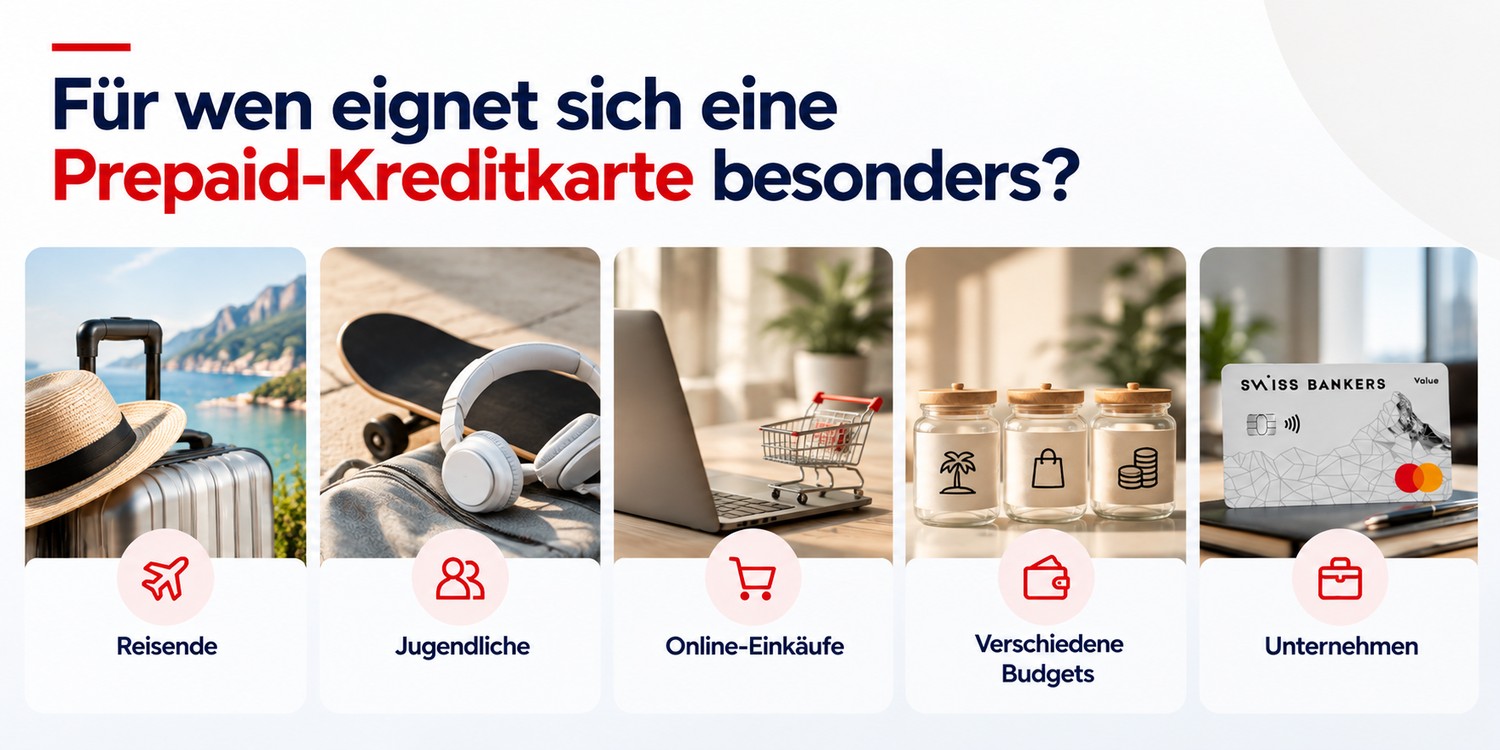
A prepaid credit card is particularly useful if you want to consciously limit your spending or keep different budgets separate. This can be useful in a wide variety of situations.

  • For travellers: When travelling, you incur many individual expenses – from restaurant bills and admission fees to cash withdrawals. With a prepaid card, you can set aside a separate travel budget for these expenses and keep your holiday spending clearly separate from your other financial transactions. This can be particularly handy if you want to decide before you set off exactly how much money you’ll have available whilst you’re away.
  • For young people and getting started with cashless payments: Anyone paying independently by card for the first time can gain experience with a fixed credit balance without having a traditional credit limit. The prepaid principle makes this immediately clear: once the available balance has been used up, the card must first be topped up again. This is a practical way to learn how to manage a limited budget.
  • For online shopping: Anyone wishing to deliberately keep their online spending separate from the rest of their finances can use a separate prepaid card for this purpose. The card will then only hold the balance earmarked for these payments – rather than every purchase being charged directly to your everyday bank account.
  • For anyone wishing to manage different budgets separately: Even those who already have a debit or credit card can use a prepaid card as a supplementary option – for example, for leisure, shopping or a fixed monthly budget.
  • For businesses and employees: Prepaid credit cards can also be useful in a business context – for example, for expenses, business travel or project-related expenditure. Businesses can provide employees with a fixed budget without them having to pay these costs out of their own pocket first.

The key point, therefore, is this: a prepaid credit card does not have to replace other cards. It can just as easily serve as an additional card for a clearly defined purpose.
Using a prepaid credit card: What should you bear in mind?

The prepaid principle is straightforward, but there are a few things to bear in mind. It’s particularly worth taking a closer look when it comes to deposits, bookings and payments abroad.

  • Ensure you have sufficient available credit: For a payment to go through, there must be sufficient credit available on the card. For certain payments, merchants may also temporarily reserve an amount – for example, when booking a hotel or at petrol station pay-as-you-go machines. During this time, the reserved amount is not available for other payments. Whether such reservations are possible with a prepaid credit card depends on the provider and the card in question. Particularly when hiring a car, a traditional credit card with a credit limit may be required for the security deposit. You should therefore check in advance which cards are accepted for bookings and security deposits.
  • Don’t forget the fees: even a prepaid credit card is not automatically free of charge. Depending on the provider and the card, costs may apply, for example, for the card itself, top-ups, cash withdrawals, foreign currency transactions or other services. You should therefore compare not only the cost of the card itself, but also the fees that arise from your typical usage.
  • Pay in the local currency wherever possible when abroad: When making payments or withdrawing cash abroad, you are sometimes offered the option to settle the amount directly in Swiss francs. This so-called dynamic currency conversion may be linked to an exchange rate set by the merchant or ATM operator. It is therefore generally advisable to select the local currency and leave the conversion to your own card provider.

Frequently asked questions about prepaid credit cards

  • Can you use a prepaid credit card to pay for subscriptions? This is often possible, provided the provider accepts recurring payments via prepaid cards. It is important to ensure there are sufficient funds on the card at the time of the direct debit.
  • What happens in the event of a refund? If a purchase is cancelled or an amount is refunded, the money is usually credited back to the prepaid card used. Depending on the retailer and card provider, it may take a few days for the credit to become available again.
  • What happens if the prepaid credit card is lost? If the card is lost or stolen, it should be blocked or replaced as soon as possible. With Swiss Bankers, a replacement card can be ordered directly via the app; any remaining balance is automatically transferred to the new card.
  • What happens if a prepaid credit card expires? Prepaid credit cards also have an expiry date. With Swiss Bankers, the existing balance is not lost when the card expires and can be transferred to a new card.

Conclusion: Prepaid credit cards: flexible payments, keep track of your spending

Prepaid credit cards combine flexible usage options with the control offered by the pay-as-you-go principle. For those who value managing their money responsibly whilst also wanting flexibility when making payments in everyday life, online or whilst travelling, a prepaid credit card is a practical addition to debit and credit cards.